Many of us love to eat rice, and for more than half of the world's population, about 3.5 billion people, rice is a staple food. The grain is not only crucial for food security, but cultivating it is an important source of livelihood for about 150 million smallholder farmers worldwide, most of whom are poor, and many of whom grow their crop on small plots of land of less than 1 hectare.
What is less well known is that rice is both a victim of and a contributor to climate change.
The effects of changing climate—rising temperatures, more frequent droughts, floods, and intense typhoons—are devastating rice farms and farmer livelihoods. However, rice production itself has an impact on the climate: significant greenhouse gas (GHG) emissions—methane, nitrous oxide (N2O) and carbon dioxide (CO2) are byproducts of rice farming and the rice value chain. Rice is responsible for 10% of global methane emissions, and in Southeast Asia, one the world's major rice bowls, rice cultivation accounts for as much as 25-33% of the region's methane emissions.
The good news is that climate-smart agriculture (CSA) solutions are available to "green" the rice we eat: these practices can increase productivity, improve climate resilience and reduce GHGs. Some of these approaches are in practice already, with encouraging results that hold promise for application elsewhere.
How does rice cultivation account for such a large volume of emissions?
Rice is grown in flooded fields, which create the ideal anaerobic conditions for bacteria to thrive on decomposing organic matter (mainly rice straw residue) and release methane. Poor absorption by the rice plant of nitrogen-based fertilizers, often overused by farmers, leads to nitrous oxide emissions.
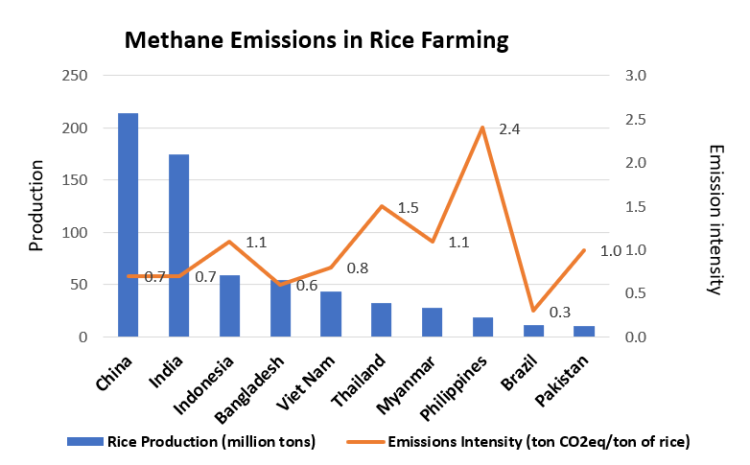
Source: World Bank staff calculation based on FAOSTAT and CAIT Climate Data Explorer 2018
Burning of rice residues and food loss and waste in the value chain add to GHG emissions. Burning is a convenient way for farmers to quickly dispose of large volumes of leftover rice straw. Vietnam’s Mekong Delta produces around 29 million tons of rice straw per year and over 80% of it is burned in the fields after harvest. Traditional drying practices (including on rural roads) and low rice milling efficiency (the ratio of milled rice output to paddy input) in many countries add to food loss and waste.
What are some of the climate-smart agriculture solutions applicable to rice?
- Changing rice production practices: Adopting CSA practices such as Alternate Wetting and Drying water management combined with good agriculture practices, such as Vietnam's 1M/5R, have shown the potential to cut methane and nitrous oxide emissions significantly. These approaches include a package of improving irrigation water delivery, land leveling, and use of improved seeds (e.g. drought-, pest-, and flood-resistant high yielding varieties), improved tillage practices, soil testing combined with improved fertilizer application, and farmer training, often facilitated by digital technology.
The successful application of these practices has been demonstrated by the Vietnam Sustainable Agriculture Transformation Project, which supported the adoption by almost a quarter million rice farm households of the government's 1M-5R program in the Mekong Delta (one "Must" of using improved seeds and five "Reductions" in irrigation water, seeding rate, nitrogen fertilizer, pesticides, and post-harvest losses in drying and milling). The program increased farmer yields by 10-18%, increased farmer profits by about 28.6%, and reduced GHG emissions by 7.3 tons CO2eq per hectare per year, while lowering water use by 15-40%.
Implementing the 1M5R approach under the Vietnam Sustainable Agriculture Transformation Project in Trung Thanh Commune, Co Do District, Can Tho Province. ? Quynh Van Pham
Similarly, the China Climate Smart Staple Crop Production Project (CSSCP) promoted farmer adoption of a CSA package for rice, consisting of improved seeds, water services, and good fertilizer, pesticide, tillage, and rice straw management practices. Farmers in Huaiyuan County, Anhui Province, where rice is a key crop, benefited from an increase in rice yields of 22%, reduced GHG emissions by about 2.9 t CO2equivalent/hectare, while cutting fertilizer and water use by 30% and 38% respectively, thus increasing farmer incomes. Building on the lessons learned, the CSSCP developed technical guidelines to enable the scaling up of these CSA packages to other regions in China.
- Better management of rice residues: Rice residues (straw and rice husks) can be repurposed for other uses, such as animal fodder, growing beds for other crops such as mushrooms, inputs for bio-energy production and the resulting by-products as organic fertilizer.
- Reducing food loss and waste. Increasing rice milling efficiency to 70% and modernizing rice storage facilities can reduce product loss, preserve rice quality, and generate GHG savings. Rice post-harvest losses in Indonesia are estimated at 10%, and in Vietnam at 10-12%. With paddy (unprocessed rice) output reaching about 99 million tons in these two countries in 2021, raising country level rice milling efficiency alone by 5%, currently at about 63.5% and 62.5% respectively, would make available an additional 4.9 million tons of rice.
- Diversification: Sustainably increasing rice productivity would allow diversification in some areas to other higher value crops that could raise farmer incomes, while cutting GHG emissions.
The Green Revolution started in the 1960s, aimed primarily at increasing rice productivity and output. Gradually, the emphasis on climate resilience has been added. Today, there is great potential to leapfrog to a Green Revolution 2.0, that mainstreams cutting edge digital technologies (artificial intelligence, internet of things, mobile apps, blockchain, etc) and pioneering science and innovation systems, to deliver the more demanding goals of increasing rice productivity, improving climate resilience and reducing rice GHG emissions. To get there, rice producers will need support. Creating an environment that will enable farmers and agribusinesses to embrace new CSA technologies and approaches will require governments, the private sector and the international development community to help finance this transition to greener production of the rice so many of us love to eat.
Category
Greening the Rice We Eat
Contributor
Greening the Rice We Eat
Country
Technical Solution