Robust standards provide scientific guidance for grain conservation and loss reduction throughout the entire supply chain. Xu Guangchao, Director of the Grain Standards Department at the Standard Quality Center of China’s National Food and Strategic Reserves Administration, offers a detailed explanation on the development of a comprehensive standards system for grain conservation and loss reduction in China.
1. Understanding Standards for Grain Conservation and Loss Reduction
1.1 The role of standards for grain conservation and loss reduction
Food standards encompass the entire process of grain production, circulation, and consumption. Strengthening both the development and implementation of these standards could provide more scientific and effective guidance and technical support for grain conservation and loss reduction efforts. In recent years, China's National Food and Strategic Reserves Administration (the Administration) has prioritized the standardization of grain conservation and loss reduction, establishing a comprehensive system of standards covering harvesting, purchasing, storage, processing, transportation, and sales. However, the effectiveness of standards depends on their implementation. Once established, they must be applied to deliver the intended benefits.

Grain harvest
1.2 Implementation initiatives
The Administration has introduced a range of measures to advance the standardization system:
? Promoting standard implementation: For three consecutive years, the "Grain and Oil Product Enterprise Standard Leader" program has guided processing enterprises in setting higher conservation standards and improving the yield rates of their products -- that is producing more finished product from the same amount of raw grain and oil materials. The Administration has also selected the first batch of grain storage enterprises to pilot green grain storage standards, encouraging more companies to apply green storage technologies to reduce storage losses.
? Strengthening publicity and guidance: Leveraging events like the World Food Day, World Standards Day, Grain Science and Technology Week, and Grain Quality and Safety Promotion Day, the Administration has widely promoted grain conservation standards through newspapers, radio, television, and new media, guiding grain producers and operators to effectively adopt these standards.
2. Grain Conservation and Loss Reduction Standards Across Different Circulation Stages
2.1 Purchasing stage
The Administration has implemented four mandatory national standards for corn, wheat, rice, and soybeans. By setting reasonable indicators, these standards play a key role in effectively promoting grain conservation and loss reduction. For example, the updated mandatory national standard for soybeans has scientifically adjusted the "rate of damaged kernel" quality indicator, raising the proportion of grade-compliant soybeans from 66% to 90%. This change not only motivates farmers to cultivate more grain but also effectively expands the pool of grain eligible for purchase, thereby supporting both productivity and conservation.
2.2 Storage stage
The Administration is committed to green loss reduction and has issued a series of industry standards, including "Technical Procedures for CO?-controlled Grain Storage," "Technical Procedures for Nitrogen-Controlled Grain Storage," and "Technical Procedures for Inert Powder Pest Control in Grain Storage." By reducing pest damage through green pest control technologies, these standards help lower grain losses during storage while promoting the adoption of green storage practices.

Grain storage
2.3 Processing stage
The Administration places strong emphasis on moderate processing and nutritional health, focusing on two key aspects:

Grain processing [Photo by Jin Mei Duo Ji/Xinhua]
2.3.1 Processing precision indicators and specifications
?Processing precision indicators:
By setting appropriate processing precision indicators, the standards guide processing enterprises to avoid over-processing and encourage consumers to shift away from excessively polished rice and highly refined flour. For example, the national rice standard sets an upper limit on processing precision, which helps retain more nutritional components and increases the total rice yield by 1.25 percentage points.
?Processing specifications:
The national wheat flour standard has lowered the processing precision requirements, reducing the number of processing grades from four to three: "refined flour," "standard flour," and "ordinary flour." Using ordinary flour as an example, the total flour yield can increase by 0.5 to 3 percentage points. The standard also clearly specifies that no additives, other than wheat flour and water, may be used in the processing, guiding enterprises to provide consumers with more nutritious and healthier flour.

Refined flour
2.3.2 Processing technology standards
The Administration has also worked to standardize product processing operations. For example, rice processing involves multiple stages including receiving wet rice, cleaning and drying wet rice, and temporary storage of finished products. The process flow, equipment selection, and operational indicators for these stages need to be standardized and managed to reduce losses at each step. Therefore, the Administration formulated the industry standard "Technical Procedures for Rice Processing," encouraging processing enterprises to adopt this standard to improve rice milling yield and the resource utilization of paddy grains For example, in the final milling stage for white rice, this standard specifies a single polishing step followed by one to two brushing processes, reducing the breakage rate by at least 1.5 percentage points.
Additionally, standards for moderate processing technologies for soybean oil and rapeseed oil are currently under development, aiming to further regulate and guide enterprise-level production and processing, thereby promoting conservation and loss reduction in the oil industry through standardization.

Grain and oil processing
3. Standards Under the Broader Food Perspective
3.1 Expanding the concept of grain
From a broader food perspective, the concept of grain is no longer confined to traditional cereals like rice, wheat, and corn. The goal of food security has evolved beyond merely ensuring enough to eat to eating well, with a focus on nutrition and health. Our sources of food have expanded beyond farmland to include grasslands, forests, lakes, and oceans. In this context, diversifying food supplies around the expanded concept of "grain" is actually a form of grain conservation. To support this shift, the Administration has concentrated its efforts in the area of standards on two fronts -- oils derived from woody plants and whole grain products.
3.2 Standards for woody oil crops
The Administration has established a standard system for oils derived from woody plants. These crops offer the distinct advantage of not competing with grain production for arable land. In addition, they are rich in various vitamins and have high nutritional value, making them a vital component in increasing the domestic supply of edible vegetable oil and supporting national food security.
To date, the Administration has issued 29 standards for oils derived from woody crops, including 7 national standards and 22 industry standards, such as "Camellia Oil," "Peony Seed Oil," "Olive Oil,” and “Olive Pomace Oil." These standards cover woody oil crops cultivated at scale in China, such as oil tea, walnuts, oil peony, and olives, playing a positive role in the healthy and orderly development of the industry. The Administration has also successfully promoted the inclusion of the camellia oil standard in the Codex Alimentarius Commission, an international food standards body established jointly by the Food and Agriculture organization (FAO) and the World Health Organization (WHO) in 1963 with the objective of protecting consumer's health and ensuring fair practices in food trade. This helps enhance the international recognition and competitiveness of China's characteristic woody oil products.
3.3 Standards for whole grains
The Administration has increased the availability of whole grain products. As China’s economy and living standards continue to grow, there is an increasing demand among residents for nutritious and healthy food. In response to this, the Administration has prioritized the development of green, high-quality, nutritious, and sustainable products. Over recent years, more than ten national and industry standards for whole grain products have been issued and implemented. These include standards for "Brown Rice," "Germinated Brown Rice," "Whole Wheat Flour," "Quinoa," and "Red Rice," covering the major rice and flour products circulating in the market.
The framework for whole grain standards is established. These standards highlight characteristic nutritional indicators as key components of overall product quality. For example, γ-aminobutyric acid in germinated brown rice and anthocyanins in red rice are important quality indicators. This has enabled more nutritious and healthy grain and oil products to reach consumers.
4. Future Directions for Standard-led Grain Conservation and Loss Reduction
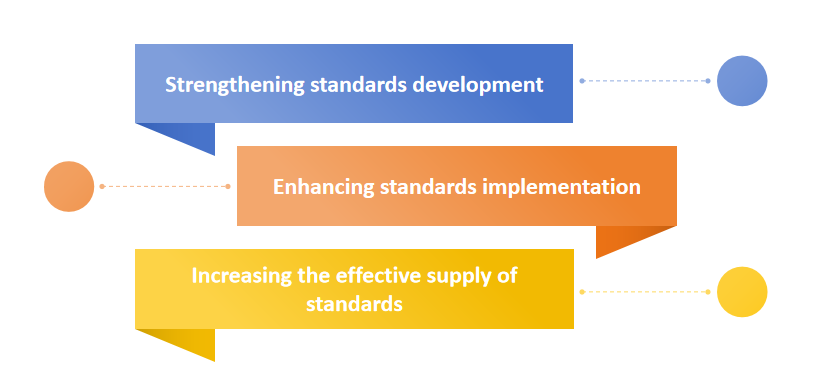
4.1 Strengthening standards development
The conservation and loss reduction of grain throughout the entire value chain requires ongoing and strong support from standards. The next steps involve focusing on the formulation and revision of key standards, including strengthening moderate processing standards for bulk grain and oil, revising whole grain standards, enhancing advanced and practical green grain storage technology standards, and accelerating the upgrade of technical standards for grain and oil machinery and equipment.
4.2 Enhancing standards implementation
The Administration will intensify the implementation of these standards, conduct pilot projects for standardized moderate grain and oil processing, encourage grain and oil processing enterprises to actively adopt the conservation standards, and promote technological upgrades in grain machinery production enterprises.
4.3 Increasing the effective supply of standards
The Administration will continue its work to increase the availability of effective standards, supporting social organizations and enterprises in developing and establishing group standards and enterprise standards, which will help boost the market supply of grain conservation standards.
Reference:
The Expert Talk video series produced by the National Food and Strategic Reserves Administration of China
Standards for Grain Conservation and Loss Reduction Across Different Circulation Stages
Related Links:
1. Corn Storage Equipment Types and Applicability
3. Corn Storage in Open-air Structures: Common Methods, Technical Requirements, and Considerations
4. Wheat Mold Prevention, Control, and Loss Reduction Techniques
5. Innovation-driven Approaches to Post-harvest Grain Conservation and Loss Reduction
6. Ensuring Quality and Reducing Losses: Rice Harvesting and Storage Techniques in China