Abstract
Initiated by China Agricultural University (CAU) and supported by various Chinese and international organizations (including IPRCC, MOST, Bill & Melinda Gates Foundation, CAAIC and the China South-South Cooperation Assistance Fund), Chinese agricultural technology has significantly enhanced maize productivity in Tanzania through targeted technical cooperation. Chinese agricultural experts, in collaboration with local partners, introduced innovative cultivation techniques and efficient farming practices to local communities, leading to measurable increases in maize yields. This technology transfer has improved food security while increasing incomes and educational opportunities. This initiative demonstrates how South-South cooperation in agricultural technology can effectively boost crop production and support sustainable development in Africa.
Maize Production Challenges in Tanzania
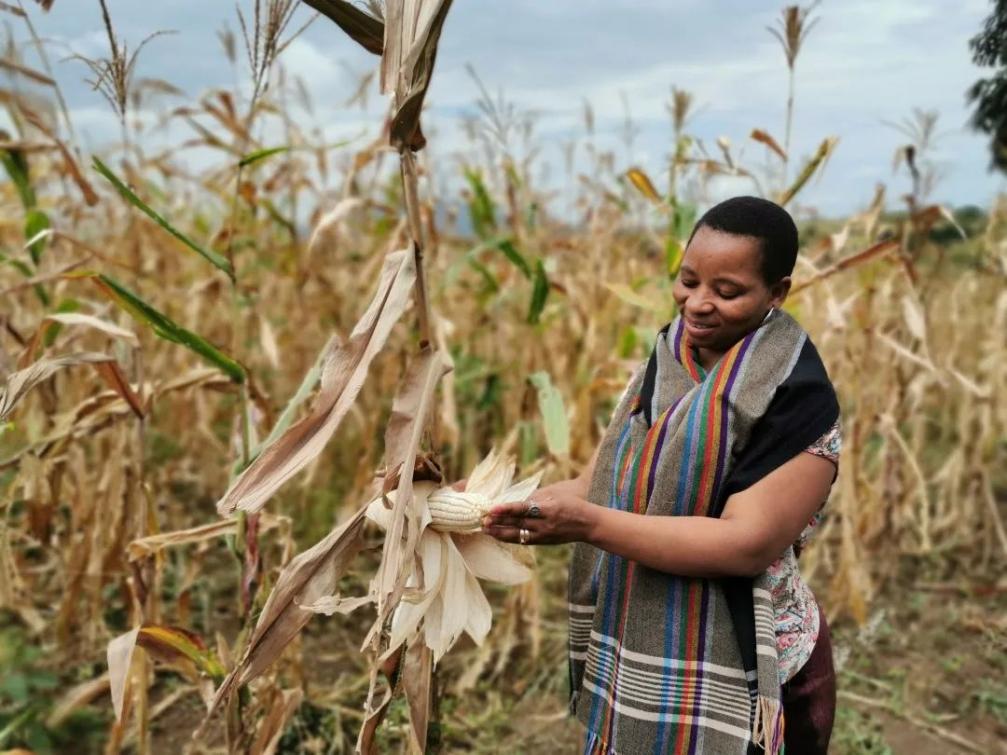
Agriculture serves as the cornerstone of Tanzania’s economy, with approximately 80% of the population engaged in farming activities. Maize is the primary staple crop in the country. Despite the availability of 4.3 million hectares of unused land, only 2.4% (approximately 100,000 hectares) was utilized for agricultural purposes in 2014. The average household had access to 2.4 hectares of land (approximately 0.1-3 hectares per person), which was two to three times the amount available during the 1990s. The growth in maize production mainly relied on the expansion of cultivated areas, with about 85% of the production increase coming from new land cultivation.
The maize yield per acre remained low, with an average of approximately 534 kilograms in 2011. This underscores the need for significant improvements in agricultural productivity. Key challenges persist in areas such as land utilization, water irrigation, fertilizer application, adoption of high-quality seeds, and agricultural mechanization, all of which pose both obstacles and opportunities for the further development of Tanzania's agricultural sector.
Enhancing Agricultural Productivity: A Pathway to Food Security
Enhancing agricultural productivity has emerged as the most pressing solution to alleviate the acute food security challenges in Tanzania. In 2009, an expert team from China Agricultural University (CAU) conducted comprehensive research to systematically compare agricultural development between China and Africa. Their findings underscored the continent's substantial untapped potential in agricultural production. The team posited that labour-intensive agricultural technologies could effectively address the paradoxical interplay between limited land availability and pervasive food insecurity in Africa. Furthermore, they emphasized the importance of strengthening synergies between agriculture and other economic sectors.

Research team members conducting household surveys
With support from the International Poverty Reduction Center in China (IPRCC) and China-Africa Agriculture Investment Co., Ltd. (CAAIC), the CAU expert team established, in 2012, a village-level poverty reduction centre in Peapea village, located within the Kilosa District of the Morogoro Regional Council in Tanzania.

Small Technology
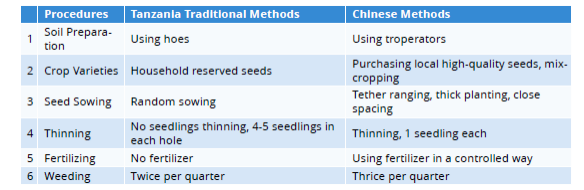
In Peapea Village of Morogoro Region, traditional maize cultivation methods yielded only 350 to 460 kilograms per acre. Farmers typically sowed household-reserved seeds randomly, without thinning seedlings, and relied on hoes for soil preparation, with minimal fertilizer and weeding. Professor Li Xiaoyun from CAU expects team posits that the primary constraint is not financial scarcity or insufficient investments, but rather suboptimal planting densities. The planting density of corn in the fields is critically low, averaging only 6,000 to 9,000 plants per acre. Under these planting conditions, the average yield of maize is confined to 300 to 500 kilograms per acre. When converted to the Chinese mu system (1 acre ≈ 6.07 mu), this translates to an extremely low yield of approximately 49 to 82 kilograms per mu. By contrast, during the same period, maize yields in China have reached several hundred kilograms or even exceeding 1000 kilograms per mu.
In 2011, Professor Li and his team developed a high-yielding dense planting strategy for maize cultivation. This strategy incorporated low-cost, low-capital-input technologies adapted from Chinese agricultural practices, supported by participatory learning and farmer-centred training (see table 1). Key components included optimized spacing techniques, intercropping with nitrogen-fixing leguminous species, manual weed control via trench digging, and organic soil amendments for water conservation. Despite challenges such as inefficient irrigation systems and suboptimal nutrient utilization, these practices significantly enhanced final yields.
Table 1 Effective Technologies Selected for the Project
Furthermore, the market-oriented soya bean/pigeon pea were selected as the variety to intercropping with maize This approach optimizes the use of the limited land areas in relatively dry weather. The height difference between maize and soybean ensures adequate sunshine and ventilation. Additionally, Parasitoid and trichogramma wasps, which feed on soybeans, serve as natural enemies of fall armyworms (FAWs) and corn borers. Scientific studies have demonstrated that Rhizobium mdiloti in soybeans roots aids in nitrogen fixation, benefiting both the soil and fertilizer for maize. The eco-supplement ratio of 2:1 for maize and soybeans may increase yields by 52.95% and 30.51%, respectively, compared to monocropping. Moreover, the exudates from soybeans can expel parasites, and the secretion of maize could promote the reproduction of the Rhizobium mdiloti. This intercropping strategy not only mitigates the risks of natural disaster and crop failure but also increases income within a single planting season.

Selection of Maize-Soya bean/Pigeon pea Mix cropping after On-Spot Consultation
Community-Driven Dissemination
The research team from CAU conducted field trials on sisal farms and maize plantations in the two pilot villages of Peapea in Kilosa District and Mtego wa Simba in Morogoro District. The team adopted community-driven dissemination approaches, ensuring that the farmers could master the technology in ways that are familiar or feasible to them.
Initially, farmer adoption was limited until Bishanga Tizetwa, then the village's agricultural extension officer, demonstrated the technology on his farm in 2012. achieving double the previous average yield. Using strategies developed by the Chinese experts and the recommended seed variety, he successfully grew maize on one acre of land that yielded over 20 bags of produce per acre, which was double the previous average of 10 bags per acre. His success served as a catalyst for broader adoption.

Tether Ranging for Distance Measurement in the Field
One of the challenges was enabling local farmers to more intuitively master the intensive sowing technique and change their traditional practice of randomly estimating plant and row spacing. In response, the expert team devised a new tether ranging method for sowing, which was subsequently widely adopted and implemented.

Sow Seeds with a “seeding rope”. Photo provided by the project team
Farmers utilized an innovative sowing tool—a rope marked with coloured ribbons every 30 centimetres (known as the "sowing rope")—to determine precise sowing points. Wooden stakes were driven into the fields, and both ends of the sowing rope were secured to these stakes. During sowing, farmers planted seeds according to the positions of the coloured ribbons on the rope, ensuring accurate plant spacing. To maintain consistent row spacing, a 75-centimeter-long wooden stick was placed perpendicular to the sowing rope. After completing one row, farmers relocated the wooden stake to the opposite end of the wooden stick and repeated the process. Experts visited the fields on multiple occasions to demonstrate and instruct farmers on the correct usage of the sowing rope. Eventually, farmers acquired the skills to craft their own sowing ropes. This method of precisely determining plant and row spacing not only enhanced planting density but also significantly facilitated subsequent weeding operations.
MPMS Approaches
Harvests are not only sustained by agricultural technologies, but also encouraged or motivated by modern management approaches. The Merit-Based Public Management System (MPMS) was implemented to enhance the performance of local agricultural staff, motivate agricultural extension of workers, and build the capacity of government officials across all levels, from local to central.
To operationalize the MPMS, two core working teams were established as the core leading organizations. One is a four-tiered working team composed of about 40 officials from the Central Government of Tanzania, the Morogoro Regional Council, seven Districts, and ten Villages. The other team is a village task force consisting of representatives from the Regional Administrative Secretariat (RAS) in Morogoro, as well as districts and village-level officials.
The ability of the regional government and district councils to support agricultural development in areas under their jurisdiction has been enhanced as a result of various capacity-building activities. Furthermore, training sessions and streamlined communication facilitated by instant messaging applications, such as WeChat, have reinforced the operational effectiveness and collaborative efficiency of all stakeholders involved.
Big Harvest

Size Comparison and Increased Produce of Maize Plantation
With the support of the Tanzanian central government, the Morogoro Regional Administrative Secretariat (RAS), and district and village stakeholders, China Agricultural University (CAU) expanded the maize yield enhancement technology to eight additional villages. The number of rural households that have adopted the project planting technology increased from nine in 2012 to 1,432 in 2020.

Tanzanian women holding harvest yields from the "Small Technology, Big Harvest" project
Following the adoption of new production methods, maize yields in the targeted villages experienced a remarkable doubling or even tripling (see Table 2). The harvested maize not only serves as a vital food source but also as a significant cash crop, playing a crucial role in enhancing food security and fostering economic growth within the country.
Table 2 Maize Produce Variation in the Project at Mtego wa Simba Village (Unit: bags/acre)

Sustaining Project Impact
Thanks to the effective utilization of the MPMS, the sustainability of the project’s interventions has been ensured by making effective use of existing central and local government structures, systems, and procedures, as well as ensuring that the four levels of governments fulfil their duties diligently. By precisely collecting information on small farmers’ highest-priority concerns, constraints, expectations, and anxieties inherent in their sociocultural environment, collaborative innovation was fostered through active learning. Such collaborative innovation within institutional design was crucial to prevent "elite capture," ensuring poverty alleviation resources were not disproportionately diverted to the affluent or more influential members of the villages. This approach sustained recipient enthusiasm, strengthened ownership, and promoted harmony between external stakeholders and local inhabitants.

Corn growth in the fields under the “Small Technology, Big Harvest” project in February 2019
This article is contributed by the project team of the "Small Technology, Big Harvest" initiative, which is part of the College of International Development and Global Agriculture (CIDGA) at China Agricultural University. For more information, please visit their official website at https://cidga.cau.edu.cn/index.html
Related Links:
1. How to Grow Maize with Good Harvest – A Maize Cultivation Guide
2. Scientific Growing for Abundant Harvest – A Soybean Cultivation Guide
Category
Technical Solution
Contributor
"Small Technology, Big Harvest" Project in Tanzania
Country
Technical Solution