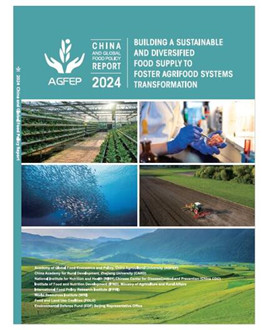
 The 2024 China and Global Food Policy Report (English version) was released on December 31, 2024. Under the theme "building a sustainable and diversified food supply to foster agrifood systems transformation", this year's report focuses on the supply system, emphasizing “nutrition-oriented” and “system thinking” approach under the “Big Food” concept—expanding food sources beyond arable land to forests, grasslands, rivers, and oceans. The report highlights the roles of alternative proteins, nutrition fortification, and midstream innovations in promoting healthy, low-carbon, and resilient diets. It also calls for diversified food imports, technological innovation, and cross-sector cooperation to enhance food security, nutrition, and environmental sustainability in China and globally.
Key Findings
First, to better meet the people’s demand for diverse, nutritious, and environmentally friendly food and to address the challenges of limited food supply resources and imbalanced supply-demand structure, China urgently needs to build a diversified, sustainable food supply system. As China’s population stabilizes and disposable incomes continue to rise, the demand for grains and cereals has reached a plateau while the demand for diverse, nutritious, and environmentally friendly food is increasing. However, China’s current agrifood supply system faces structural problems such as over-reliance on arable land, extensive and unsustainable production mode, and high import ratios for certain categories.
Second, embracing a healthy dietary approach and fully leveraging the potential and benefits of natural resources such as forests, grasslands, rivers, and lakes, can cater to residents' diverse nutritional needs and mitigate environmental impacts. In 2022, food sourced from arable land constituted 83.5% of China’s total food energy, while forest and grassland products, aquatic harvests, and livestock accounted for only 4.8%, 0.4%, 1.5%, and 10%, respectively. Despite this, non-arable resources are pivotal in providing protein-rich, nutrient-dense foods. A comprehensive strategy to develop and utilize these varied production resources will boost the output of forest and grassland products, aquatic foods, and future food alternatives, fostering healthier and more varied diets for residents. This integrated approach could conserve 6.5 million hectares of arable land and cut carbon emissions by 180 million tons, marking a 19% reduction.
Third, advancing the alternative protein industry eases the strain on the livestock sector, preserves water and soil resources, curtails greenhouse gas emissions, and bolsters the resilience of agricultural food systems. By substituting plant-based meats for 10% of pork and beef, cultured meat for 1% of pork and beef, plant-based milk for 15% of dairy, and insect protein feed for 10% of soybean meal, we project a reduction of 8.2% and 16.6% in livestock and dairy production, respectively, by 2035. This shift would also lessen the demand for grains and soybean meal by 15.9 million tons and 9.23 million tons, correspondingly while conserving 1.2 million hectares of arable land and decreasing agricultural carbon emissions by 9%.
Fourth, optimizing the midstream stages of food supply through measures like food fortification, whole-grain provision, and food waste reduction can amplify the efficiency of food supply chain, enhance the utilization of limited arable land resources, and yield notable nutritional benefits. China currently loses over 170 million tons of food in post-harvest processing, storage, transportation, and marketing, resulting in a land footprint exceeding 10 million hectares, protein losses surpassing 7.5 million tons, and fat losses exceeding 5.2 million tons. Developing fortified and biofortified foods can effectively address micronutrient deficiencies for residents, particularly benefiting low-income groups. Increasing the provision of whole grains can reduce medical costs linked to associated ailments, increase usage efficiency of food, and diminish carbon emissions.
Fifth, China’s food imports exhibit a significant concentration, necessitating enhancements in stability and dependability. The country’s food trade reflects a trend where import growth outpaces exports, leading to a burgeoning trade deficit. The import structure is skewed, predominantly focusing on grains, oilseeds, and meat, constituting over 60% of total imports. Despite the ongoing import concentration, the source countries are undergoing a shift: reliance on the United States is diminishing while dependence on countries and regions such as Brazil, Russia, and ASEAN is increasing.
Policy Recommendations
1. Transformating Agrifood Systems. Leveraging technology development, policy reforms, business initiatives, and international collaboration, China can spearhead the development of a diversified food supply system under the “big food” concept. This strategic shift serves as an important case for global agricultural food systems transformation and strengthens food and nutrition security. It involves concerted efforts in production, processing, distribution, and consumption to achieve integrated and optimized supply chains. Technology policy, business, and international cooperation must continue to reform and optimise to support the construction of a diversified food supply system.
2. Constructing a Healthier and Sustainable Food Production System. It demands to set strategic goals based on the “big food” and “big resources” concepts. Detailed plans and pathways for optimizing food sources must be meticulously researched and refined. Encouraging the sustainable development of various food resources simultaneously achieves ecological resource protection and utilization. Government guidance is needed in fostering deep engagement from enterprises, scientists, and other stakeholders in developing various food resources. Optimizing policy support systems, increasing investment in key areas like forests, grasslands, water resources, facility agriculture, and future foods, and fostering research and development of new products and technologies will help to supply healthier, ecologically sustainable, and affordable foods.
3. Promoting Alternative Protein Industry Development. Simultaneous efforts in supply, demand, and policy are needed to drive the growth of the alternative protein industry. This entails increasing research and development investment, improving product quality, reducing production costs, and promoting interdisciplinary integration. On the consumption side, targeted promotional efforts, consumer guidance, and tailored marketing strategies are essential for more acceptance of alternative proteins. Accelerating the enhancement of standards, regulatory systems, and sustainable industry development is also needed for long-term success.
4. Enhancing Food Nutrition Utilization. Standardizing industry norms, reinforcing policy guidance, and leveraging technological advancements are key to optimizing food nutrition utilization. It calls for collaborative efforts among government departments, processing enterprises, and research institutions to establish a regulatory framework for food loss and waste assessment and enhance investment in research and development across various sectors.
5. Engaging in Global Governance. Deep engagement in global food supply system governance can enhance China’s diversified food supply, promote global food security, and ensure stable food trade sources. Improving the business environment, encouraging participation in global food industry cooperation, enhancing global competitiveness, and actively contributing to global governance frameworks must be facilitated for sustainable development.
Click here to access and download the full report for more detailed information.
Related Links:
China and Global Food Policy Report 2025: Low-Carbon Transformation of Chinese Agrifood Systems
Agrifood System Carbon Emissions and Reduction Policy: Insights from China and Africa